



A sweater does a lot of work on its own. It keeps you warm, it carries colour, and it often becomes the whole outfit. That is also why the small things go wrong so visibly: a hem that lands in the wrong place, a neckline that swallows a face, one layer too many. None of these are hard to fix. They just need a second look before you walk out the door.
Here are the five mistakes that come up most often, plus the adjustment that solves each one.
1. Wearing Two Big Things at Once
The most common proportion problem is volume stacked on volume. A chunky cable knit over wide-leg trousers, or an oversized cardigan with a full midi skirt, turns the body into one soft rectangle. There is nothing wrong with any of those pieces. Together, they cancel each other out.
Fix it by giving each outfit one hero. If the sweater is roomy, keep the bottom half closer to the body: straight-leg jeans, slim trousers, a pencil skirt, leggings with tall boots. If the bottom is wide or pleated, choose a sweater that sits at or just above the waist and stays fairly fine in gauge.
Quick formulas that work
- Oversized sweater + straight or slim trousers + a defined boot.
- Fitted turtleneck + wide-leg pants + a belt at the waist.
- Crop knit + high-rise anything, so the hems nearly meet.
- Long tunic sweater + narrow leg + a shoe with a bit of height.
Check the sleeve too. Most knits stretch, and a sleeve that has crept past the wrist bone reads as borrowed, even when the body fits. Push cuffs to mid-forearm or roll once.
2. Tucking the Wrong Sweater the Wrong Way
Tucking is the fastest way to change a silhouette, but it has rules. A full tuck into a high-rise waist creates a clean line. A front tuck adds waist definition without a bulge at the back. Both work well in fine-gauge cotton, merino, and ribbed knits with some drape.
Both fail in thick, stiff yarn. If the sweater is bulky, a full tuck adds inches under your waistband, and a front tuck leaves a shelf of fabric at the hip.
What to do instead:
- Shallow front tuck. Take only the front inch or two of the hem, not the whole panel.
- The elastic trick. Gather a small section of the back hem with a hair elastic, fold it under, and smooth. The sweater shortens without a tuck.
- Crop by design. Choose a shorter hem rather than fighting a long one.
- Leave it out. Let the sweater be the shape, and pair it with a narrow bottom.
3. Pairing Colours Without Enough Contrast
Two mid-tone colours side by side — a soft grey sweater and faded blue denim, say — can look washed out rather than relaxed. The problem usually is not the hue. It is the value. If two pieces sit at roughly the same lightness, they blur together.
Push one direction. Dark sweater with light trousers. Cream knit with deep indigo or black. Camel with charcoal. That contrast gives the outfit shape without a single accessory.
The other colour mistake happens near your face. A sweater very close to your skin tone, in the same value, can flatten your features. A scarf, a collared shirt peeking out, or one step of contrast — cream instead of beige, dusty rose instead of blush — brings definition back. Monochrome outfits do work, but lean on texture: a smooth knit against a ribbed one, wool against denim, so the eye has something to read.
4. Layering for Warmth Instead of Shape
Layering goes wrong in one of two ways: too many mid-weight pieces, or a bulky knit under a jacket that then refuses to close. Both end in a padded look and a lot of tugging.
Layer thin to thick
Start with the finest piece, not the warmest. A fine merino or cotton knit sits close to the body and slides under everything else. Then add bulk outward. If you are wearing a heavy sweater, it belongs on the outside, or under a coat with room to spare.
Collar tricks that add polish
- A shirt under a crewneck or V-neck, collar points out and cuffs showing.
- A turtleneck under a V-neck or buttoned cardigan, so the neckline frames the knit.
- A long-sleeve top under a sleeveless knit vest, useful in transitional weather.
- If the jacket will not close comfortably, the sweater is too thick. Swap it, do not squeeze it.
5. Skipping the Accessories That Fix Everything
The neckline is a frame, and it decides what your jewellery should do. Crewnecks and boatnecks leave open space, so a short pendant or a chain that sits in that gap pulls the eye up. A turtleneck fills the space itself; wear earrings and skip the necklace. A V-neck can take a pendant that follows the line, but not one that fights it.
Belts can work over a fine-gauge cardigan if it is smooth and thin. Over chunky knits, they bunch and distort the stitch. And check the bag strap: a thin strap across a heavy cable knit digs in and pulls the shoulder out of shape, while a wider strap or a handheld bag sits better.
One more thing worth noticing: shoes. If an outfit reads flat, a darker shoe anchors it. If it feels heavy at the bottom, a lighter shoe lifts it.
The 60-Second Check Before You Go
Stand back from the mirror and run through this list. Most fixes take less than a minute.
- Is there only one oversized element in the outfit?
- Does the sweater hem land somewhere intentional — waist, hip bone, or long?
- Do the sweater and the bottom half differ in value?
- Can your outer layer close without pulling?
- Have you adjusted the cuffs and the neckline?
- Is the bag strap resting on the knit without stretching it?
Get those six things right and the sweater stops being the piece you cover up with. It becomes the piece the whole outfit is built around.
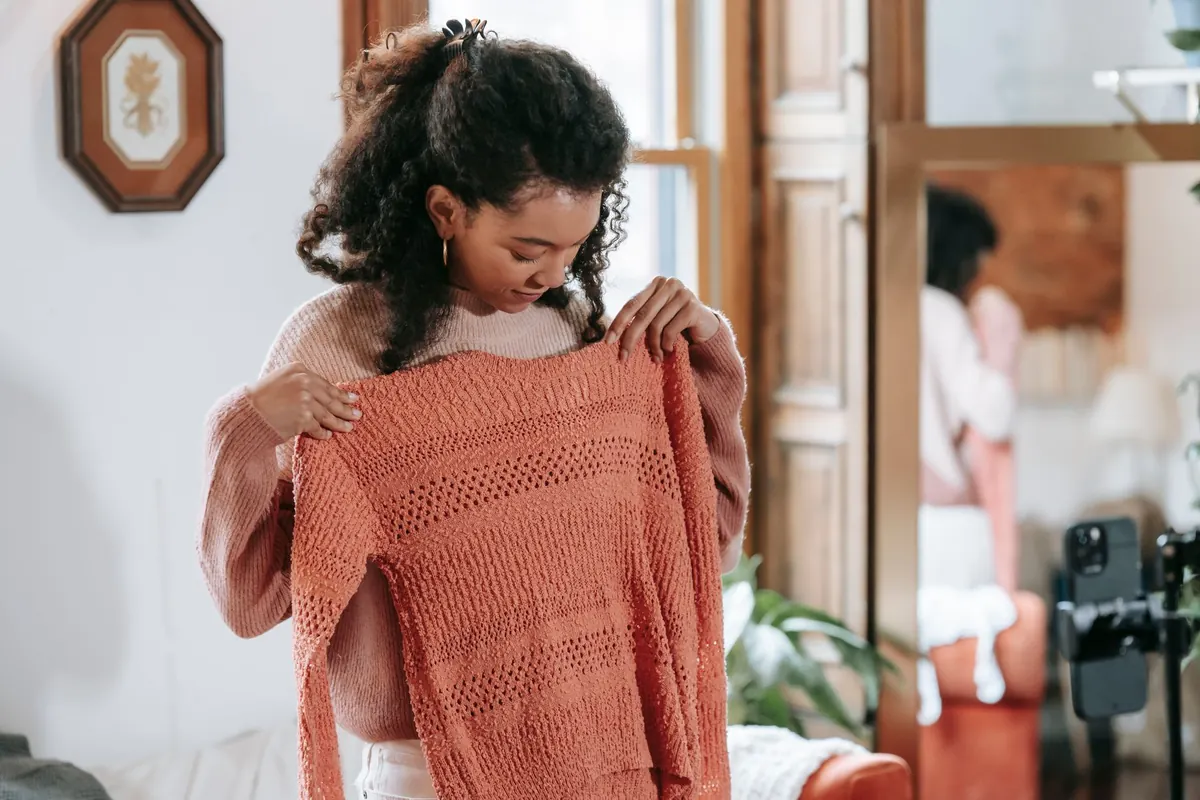
Photo: Miriam Alonso / Pexels